Fish Aggregating Devices (FADs): Acoustic Tagging + Camera Monitoring
2020 to present
Partners: Louisiana State University (LSU), Destin-Fort Walton Beach Natural Resources Team
The Captain Kelly Windes FAD Buoy Network, named for the former Okaloosa County Commissioner who championed the project, was the first FAD buoy deployment in the continental United States, with the first eight buoys placed 60 to 80 miles offshore in August 2020. A second set of eight FADs were deployed 20 to 25 miles offshore in 2025 bringing the total to 16 FADs offshore Destin- Fort Walton Beach. Beyond their function as a recreational and charter fishing resource for pelagic species such as tuna, wahoo, marlin, and mahi-mahi, the FADs serve as a platform for ongoing research.
In partnership with LSU, each FAD is equipped with an acoustic receiver that detects and logs tagged marine species passing nearby, supporting a broader program of acoustic tagging of tunas and other pelagic species to study residency time and movement between structures. Underwater cameras have also been attached to FADs to document species assemblage at the structures. Topside, additional cameras were installed to quantify patterns of human use. The research builds on a growing global body of literature on FAD-associated fish behavior, giving DFWB’s program a chance to contribute Gulf-specific data to a field historically dominated by Pacific and Indian Ocean tuna studies. This data will also support the maintenance of the current FADs to ensure not only a destination for fishing activities but also a novel research platform for future research opportunities.
Events in Destin-Fort Walton Beach
It’s always the best time of the year to visit Destin-Fort Walton Beach, Florida. Mild temperatures and warm gulf waters make the area enjoyable no matter the season. And with a running lineup of exciting local events and festivals, there’s always something to do in Destin-Fort Walton Beach!

October 10, 2026 - October 11, 2026
Repticon
Repticon is a premier traveling reptile and exotic animal expo,…
See details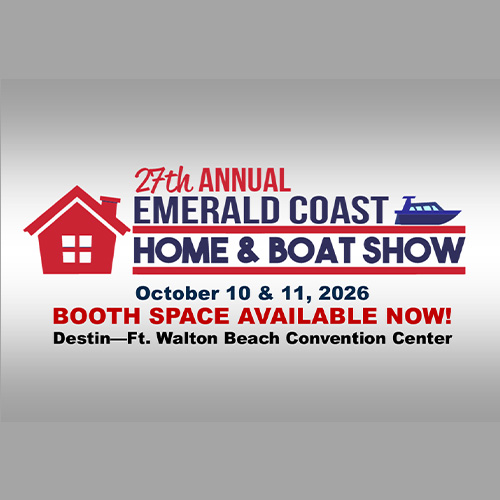
October 10, 2026 - October 11, 2026
27th Annual Emerald Coast Home and Boat Show
Welcome to the 27th Annual Emerald Coast Home and Boat…
See details