What’s Buzzing along the Coast?
Beneath Northwest Florida’s sugar-white sands, a secret life waits to emerge – timed perfectly with the bloom of a single golden flower. Look below the surface to see what’s buzzing along the coast.
Gulf Coast Solitary Bee (Hesperapis oraria)
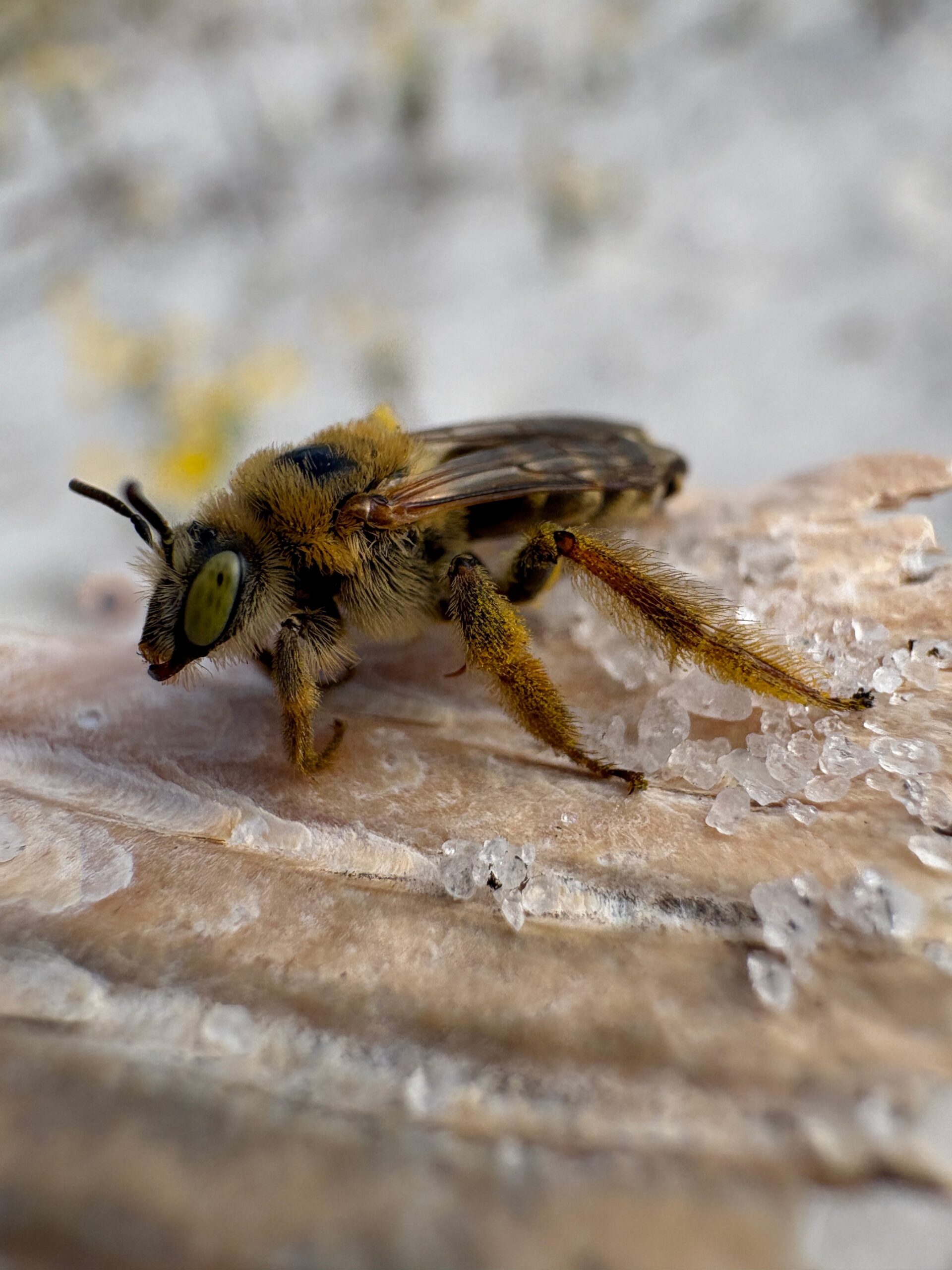
The coastalplain honeycombhead (Balduina angustifolia) is a native wildflower that can be seen blooming along Northwest Florida beaches and has a mutualistic relationship with the Gulf Coast Solitary Bee (Hesperapis oraria). This bee lives solitary underground, only coming above ground to pollinate and reproduce in the month of October, when the honeycomb flower is in bloom.
This bee was first discovered by Jim Cane in 1996, however there is no extensive research about the bee. Recently, a graduate student with the University of Florida, Milton campus, conducted more preliminary research about this bee. They discovered this bee is only above ground for 3 weeks, and the males are the first to come out of the burrows.
The bees can be seen sleeping under or on the top of the flowers from around 7-9am and begin to pollinate and feed from around 9-12am. The females are the only ones who pollinate. If you see the bees flying, they are easily identified by fuzzy yellow legs.
The bees exhibit sexual dimorphism, where the females are much larger than the males. Biologists think the females return to the burrows to sleep at night and use the pollen they collect during the day to coat and protect their egg.
Three years ago, the biologists at UF were able to identify and locate one solitary bee nest at Henderson Beach State Park in Florida. Staff and researchers excavated the nest to learn more about the bees nesting process. They discovered the chamber where the female bee laid her nest, was a meter underground in the sand. During this inventory they only found one egg and one chamber, but there could be multiple chambers as similar species to the genus Hesperapis, show nest characteristics with multiple nest chambers.
There is still more to learn about this bee and while it is not listed as a protected species it is a species of interest. The Gulf Coast Solitary Bee has only been found in Northwest Florida despite the honeycomb flower being found throughout the entire state of Florida.
Events in Destin-Fort Walton Beach
It’s always the best time of the year to visit Destin-Fort Walton Beach, Florida. Mild temperatures and warm gulf waters make the area enjoyable no matter the season. And with a running lineup of exciting local events and festivals, there’s always something to do in Destin-Fort Walton Beach!

October 10, 2026 - October 11, 2026
Repticon
Repticon is a premier traveling reptile and exotic animal expo,…
See details
October 10, 2026 - October 11, 2026
27th Annual Emerald Coast Home and Boat Show
Welcome to the 27th Annual Emerald Coast Home and Boat…
See details